Kingdom’s Dawn by Chuck Black is a book that I grew up with as a high schooler. As a kid, I was only sort of interested in following God and reading the Bible, but I was very much interested in knights, swords, and the battle of good versus evil. This made the Kingdom Series an excellent series for me as it engaged my mind with Scriptural ideas while being entertaining. Below is my review of the book and an engagement with its theology now that I have read it again as an adult.
Brief Overview
Kingdom’s Dawn follows a young man named Leinad as he matures into adulthood. Leinad finds it strange that he is being trained by his father to be a skilled swordsman despite being a farmer. What possible reason could a farmer have for knowing his way around a sword? It does not take him long to learn why when he is called upon by the King to fulfill a dangerous and difficult mission. This mission leads to many perils that leave Leinad wondering if the King is really worth following. Can he maintain his faith in someone he has never met?
Despite its ease of reading and short length, this book is sprawling in scope as it parallels the biblical narrative from Seth through Moses. It is, as I like to say, the Bible in parable form.
Things I Liked
I am a huge fan of Chuck Black’s attempt at framing biblical truths into a story of knights and valor. Growing up I cared much more about the knights than the biblical message; however, even then I found the biblical parallels intriguing. As I read the book again as an adult, I found the parallels much more engaging. This is definitely a book that I hope to read to my kids when they are a bit older.
Another thing I liked is that it does not water down the biblical stories too much. You know how children’s stories about the Old Testament are often all sunshine and rainbows? This book does not do that. It is not gory by any means, but when it gets to things like the flood, it is appropriately violent. The flood wiped out the entire planet. It was a violent event. Chuck Black does a good job of toeing the line between accurate representation of the biblical narrative without being gory. Keep this in mind if you plan on reading it to your kids, but I would also encourage you to remember that the Bible has lots of violence that we should not necessarily be protecting our kids from.
Additionally, I like the fact that Leinad faces some very tough challenges even though this is a children’s book. Likewise, the book has lots of very good word pictures of how things like discipleship should look. Discipleship is something that we do not do very well in many of our churches, but if we can raise our kids with the knowledge of how to effectively do discipleship, we can change this. Kingdom’s Dawn helps in this regard.
The final aspect of the book that I love is the discussion questions at the end of the book. Each chapter has a set of questions aligned to it. These can be gone over at the end of each chapter like a Bible study which I find quite nice to tie the book in even more to Scripture, especially when reading it to a younger audience (the target audience).
Things I Didn’t Like
I am not going to address much here simply because most of the things I didn’t like will come out in the theological engagement section.
The main thing I didn’t like about this book as an adult (that is not theologically based) is that it is really too easy of a read. This makes sense as the target audience is likely middle school kids. That said, these books give me a yearning for a similar series to be written for adults. If anyone has any recommendations, please let me know in the comments or on Facebook!
Theological Engagement
This section has spoilers. It is meant to give specific problems with the theology found in the book. If you do not want spoilers, you can look at the picture to get an idea for how good the theology is and then skip to the next section.
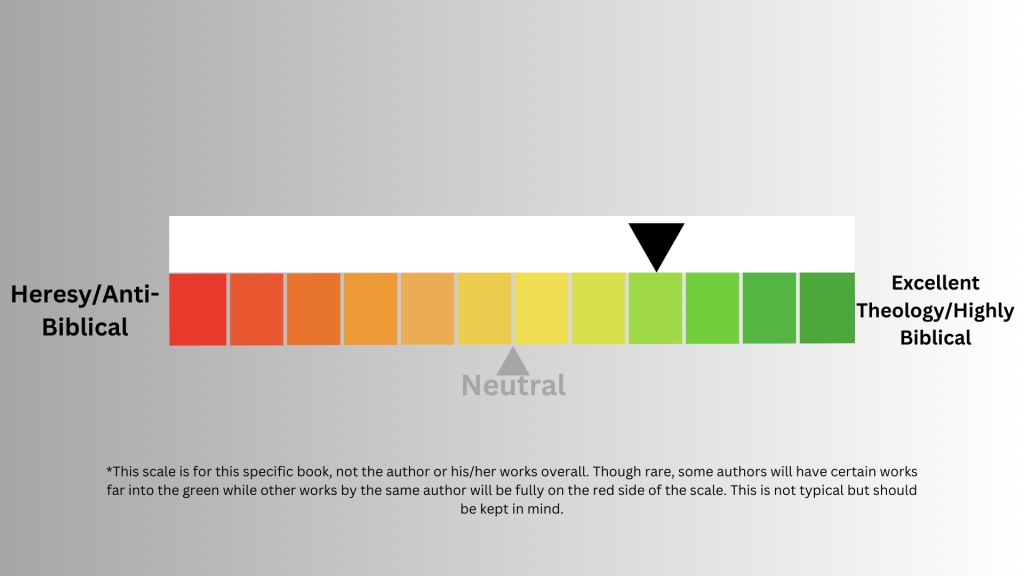
If you have ever heard me talk about these books, you may be surprised by how low I put this on the scale above. Much of the theology of the books is rather solid; however, some distinct and serious issues are also found within. Also, I want to state one thing about Christian fiction, especially those that try to follow the biblical narrative closely. Christian fiction authors must take some creative license in the retelling of the biblical narrative or we simply get an exact retelling that probably had no good reason to be written. In general, I believe that we should be willing to overlook small deviances in these books and write them off as a necessary part of the writing process. That said, sometimes things are taken too far. This is where things can get problematic, especially if the book is written with the intent to teach biblical truth. Christian fiction authors must walk a very fine line. I would argue that Kingdom’s Dawn steps over that line on one major account that sends shockwaves through the book.
No magic is not good for a book that involves God and Scripture so heavily.
Interestingly, pretty much all of the theological issues with this book stem from the fact that there is no magic. This was clearly an intentional thing that Chuck Black did. On the surface, this omission may seem to be a good thing. However, if one digs just a touch below the surface, one will quickly realize that no magic in a story that is essentially a parable of the Bible is problematic. To begin with, God is not natural. In fact, he is supernatural. That means he is beyond nature. When God does something that is not natural he is doing magic. That is literally the definition of magic-something that happens, or seems to happen, due to supernatural means. We tend to use the term “miracle” to describe magic done by God, but that does not detract from the fact that “magic” is an entirely appropriate term for what God does.
But why is this a problem? Why am I so strident in my defense of magic in regard to God? Well, Chuck Black has written a parable of the book of Genesis and the first few chapters of Exodus. He has done so without the use of magic of any kind. Though there are others, I am going to give three distinct examples as to why this is a problem.
The Flood
The flood is one of the events shown in the book. However, instead of being a divine judgment from God against an extremely wicked generation, it is merely a natural disaster that comes upon an unsuspecting land. It is a plague of tiny creatures that are called the Vactor Deluge that devour everything in their path. The single most cataclysmic event in the history of mankind has been reduced to a natural disaster (though I suppose that the fall of man could be argued as being similarly cataclysmic). This is exactly what secular science has done with the flood. They tell the same story of there being one or more cataclysmic events that wiped out entire populations of animals; however, instead of this event being a global flood due to the divine wrath of God, it was a meteor. A meteor killed the dinosaurs and all the other creatures we find fossilized. The flood was a supernatural event caused by God. He may have used natural resources (the fountains of the deep and relentless rain), but it was begun and sustained by God.
God Becomes Powerless
The example of the flood above is also an example of this point. That said, I want to take this further. Rather than God having the ability to heal wounds and raise the dead, a flower called the life spice is what gives near-magical healing properties. The King (God) cannot just heal someone. He must use the flowers. Another example is that the King is unable to create Arrethrae. He merely chooses to make a kingdom from the land and people who already exist. In a world with no magic, the King cannot have created the world and thus he is merely part of the world itself, a product of the natural order of the universe. This is scientific naturalism. Scientific naturalism is the idea that there is no God and everything in the universe, including the universe itself, came about by random chance and through a long series of natural processes. Arrethrae, without magic, had to have come about in the same way. The King has no power to create the universe.
The Holy Spirit Doesn’t Exist
The final area to look at is the lack of the Holy Spirit. Logically, it makes sense that he must not make an appearance in this book series. Afterall, he is a spirit in a world that has nothing to do with the supernatural. The problem with this is that the Holy Spirit is the third Person of the Trinity. Black’s insistence on no magic has come to the logical end of necessitating the removal of the Holy Spirit from the Godhead in his story. This is highly problematic. The Christian God is a triune God. We believe in the Father, Son, and Holy Spirit as being both distinct Persons and one God. A theological or philosophical position that requires us to remove a member of the Trinity ought to be rejected.
Would I Recommend This, and to Whom?
While the theological issues above are indeed problematic, I believe that this book is really a good book for youths and, if you are okay with a very easy read, adults. The book is clean, does a solid job of following the biblical narrative (albeit sans magic), and is entertaining. I actually recommend reading it to your kids as it can be a good way to bond and have some interesting biblical/theological discussions.
I want to hear your thoughts! Have you read Kingdom’s Dawn? Did you enjoy it and/or find it valuable? If you haven’t read it, does this sound like a book you are likely to read? Let me know in the comments!
If you would like to read Kingdom’s Dawn for yourself, you can buy it here.
Also, please consider liking this post and subscribing to this blog to stay up-to-date on future posts. You can also see these reviews on YouTube in a less formal setting. Here is the link to this specific review. Additionally, you can follow me on Facebook, BookBub, and Goodreads! Thanks for reading!
Share this:


 L. J. Anderson - Author and Blogger
One thought on “Kingdom’s Dawn. The Kindom Series Book One. Chuck Black. New York: Multnomah Books, 2006: Book Review by L. J. Anderson”