Summary
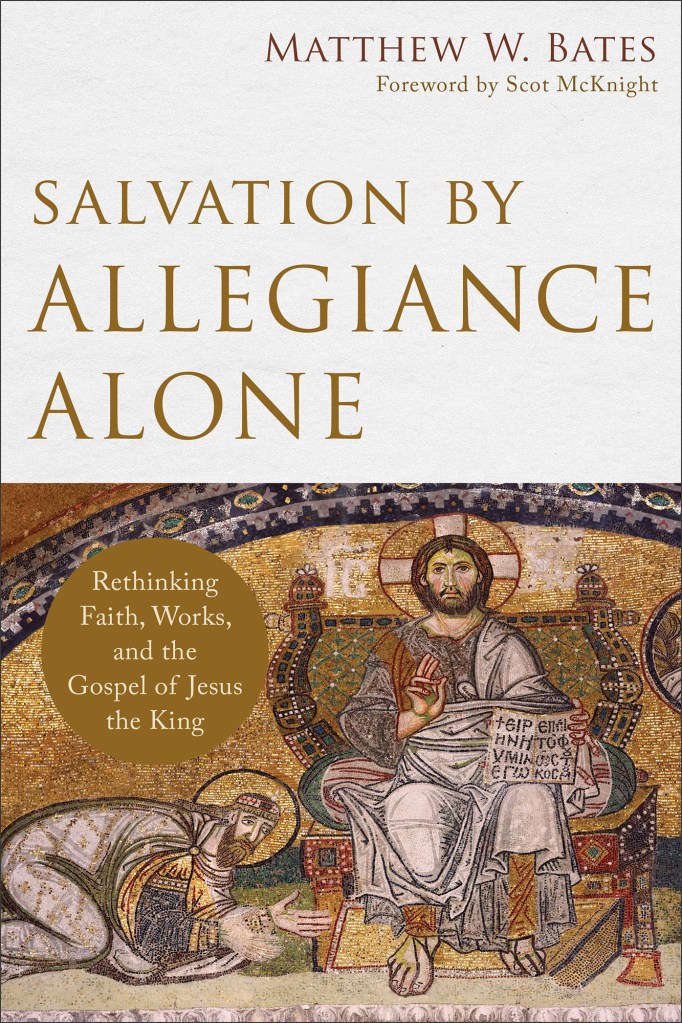
Salvation by Allegiance Alone by Matthew W. Bates can be summed up with one of his early questions: “When the Apostle Paul says, ‘for it is by grace you have been saved through faith’ (Eph. 2:8), what if Paul’s idea of ‘faith’ (pistis) differs from typical contemporary understandings?” (p. 3). The book revolves around that single question, arguing that the Greek word pistis (typically translated as “faith”) ought instead to be rendered “allegiance” or “fidelity.” The title makes this clear. In fact, that sort of blunt clarity is one of the book’s strengths. Whether you agree with him or not, you can’t miss what he’s trying to say.
Although the book is academic in nature, it isn’t inaccessible to a popular-level audience. If you’ve had some theological training or have been a Christian long enough to wrestle with biblical theology seriously, you’ll be able to follow Bates’ argument. That said, this isn’t a book for casual reading. It assumes a decent familiarity with New Testament studies, theological vocabulary, and basic Greek translational issues.
Strengths
The first major strength of Bates’ work is his integration of Scripture. He doesn’t just reference verses in footnotes or isolate them as standalone quotations. Rather, he weaves Scripture into the narrative of his paragraphs so that biblical citations become part of the rhetorical structure itself. This creates a theological style that is immersive rather than didactic. For readers who value a strong biblical foundation for doctrinal argument, this feature of the book will be refreshing.
Second, Bates is willing to challenge Protestant dogma, especially the Reformational emphasis on “faith alone.” He argues that modern definitions of “faith” often reduce salvation to a kind of cognitive assent—mental agreement with a set of truths about Jesus—while neglecting the relational and covenantal nature of true saving belief. Bates instead proposes that saving pistis includes loyalty and embodied devotion to Jesus as King. In his words:
“How many beams of good works must we toss aside as we strain to find the sawdust speck of ‘faith alone’ before we start to wonder precisely how this salvation house has been constructed?” (pp. 12–13).
Bates rightly emphasizes that the gospel is not merely about Jesus’ death and resurrection but also about his enthronement as Lord (p. 67). In a world where the gospel is often reduced to a ticket to heaven, his insistence that Jesus is a reigning King who demands allegiance is a powerful corrective.
Weaknesses
While the argument is provocative and well-framed, there are weaknesses. Some are minor, some more substantial.
A minor critique involves Bates’ ecumenical caution. Early in the book (around p. 17), he appears hesitant to speak critically of groups that significantly diverge from orthodoxy. For instance, he softens his response to Mormon theology, presumably to avoid offense or institutional backlash (Bates teaches at Quincy University, a Catholic institution, despite being Protestant). While academic charity is important, theological clarity should never be sacrificed on the altar of professional diplomacy.
A more serious flaw, however, is the central linguistic claim of the book. Bates argues that we should regularly translate pistis as “allegiance.” Yet James 2 stands in clear tension with this proposal. James differentiates between faith and works, not in opposition, but in complementary roles, saying that “faith without works is dead” and that “a person is justified by works and not by faith alone” (James 2:24). If pistis meant “allegiance” in James, then the distinction between faith and works collapses. The entire contrast James sets up would become incoherent.
Theological Engagement
Theologically, Bates is entering into a long-standing debate: What does it mean to be justified by faith? While Protestants have long affirmed sola fide, Bates suggests that the Reformers misunderstood what pistis actually conveyed. Rather than being about belief in a set of doctrines or even trust in a person, Bates argues that pistis in its original first-century usage connotes a relational loyalty to a figure of authority, in this case, Jesus the Messiah.
This resonates with recent scholarship that has highlighted the imperial context of the New Testament. Caesar demanded allegiance from his subjects. So when Paul and the early Christians proclaimed Jesus as “Lord,” it was a direct confrontation with imperial ideology. In that sense, Bates is right to reframe faith as more than mental assent.
Bates’ model raises important questions about how we define justification and sanctification, especially in relation to Paul’s letters. While he rightly challenges the Protestant tradition’s overly cognitive definition of faith, his proposal to translate pistis as “allegiance” across the board may go too far linguistically. The deeper issue, however, lies not with the concept of allegiance itself, but with the attempt to retain traditional Protestant frameworks while redefining the key terms. Rather than separating justification and sanctification as distinct phases, Scripture often treats salvation as a holistic process, one that begins with faith but necessarily includes ongoing obedience. In this way, Bates gets the direction right, but may stretch the language beyond what Scripture demands.
In my own forthcoming book (which approaches this subject from a different direction), I argue that the Bible does in fact require devotion and obedience for salvation, but I do not go so far as to suggest we redefine or retranslate pistis. Instead, I argue that faith and obedience are distinguishable but inseparable. Faith begins the salvation process and must remain throughout, but Scripture teaches that without ongoing obedience, salvation will not be brought to completion. James affirms this. Paul does not deny it. The tension lies not in Scripture, but in our systems.
Takeaways
- “Faith,” as we commonly understand it, may be insufficient. At minimum, it must be richer than mental assent.
- “Allegiance” is a helpful theological category—but it should supplement, not replace, faith.
- Biblical theology must be rooted in Scripture, not in reactionary Protestant slogans.
- Contemporary Christianity is suffering from a minimalist gospel—this book is a step in the right direction to challenge that.
- Be discerning. While Bates provides needed insight, his proposal goes beyond what the biblical text can consistently sustain.
Conclusion
Salvation by Allegiance Alone is a serious, scholarly work that challenges assumptions and sparks valuable conversations. While it goes too far in redefining pistis as “allegiance” across the board, it does highlight a real problem in how modern evangelicals speak about salvation. Bates’ emphasis on devotion, fidelity, and the lordship of Christ is desperately needed in a Christian culture that often treats salvation as a box-checking exercise.
I recommend reading this book if you are prepared to critically engage with it, especially if you’ve grown up hearing “faith alone” without ever examining what that phrase really means in context. Read it with your Bible open, your pen ready, and your theological filters engaged.
Interested in reading Salvation by Allegiance Alone? If you want to support me, you can buy it directly from me here or from Amazon here (this does not support me). If you do read it, please come back and leave a comment to share your thoughts!
Also, please consider subscribing to this blog to stay up-to-date on future posts and book releases. You can also see these reviews on YouTube in a less formal setting. Here is the link to this specific review. Additionally, you can follow me on Facebook, BookBub, and Goodreads! Thanks for reading!
L. J. Anderson
Share this:


 L. J. Anderson - Author and Blogger