The Problem of Divine Timing in Creationism Debates

One of the most overlooked questions in the creation debate is also one of the most personal. It touches God’s character, his compassion, and his nearness to the world he made. The question is simple: How long has God allowed his creation to suffer without a clear, revealed word from him? This is what I call The Problem of Divine Timing. It is an argument for young earth creationism that is specifically against any form of old earth creationism. While it is not an argument that will convince a non-believer, I believe it is a strong argument that needs to be dealt with if one professes to be a Christian. Additionally, this is a slightly expanded form of the argument I gave in Contending for the Truth: A Biblical Look at Thirteen Contentious Doctrines.

Continue reading “The Problem of Divine Timing in Creationism Debates”

Was Adam Real? Why the Historical Adam Matters for Christianity

If Adam was just a myth, then sin is just a myth. And if sin is a myth, then the cross is meaningless. This is why the question of the historical Adam is not a side issue. It goes to the very core of Christianity. Let’s walk through why Adam’s historicity matters across four areas: history, the Bible, theology, and philosophy.

Continue reading “Was Adam Real? Why the Historical Adam Matters for Christianity”

Context Is King: On Charlie Kirk, Quote Mining, and Truth in Context

When it comes to truth, context is king. Take any statement, any truth claim, and rip it out of the context from which it was originally stated, and the product will be ultimately false even though it appears true on the surface. Two days ago, on September 10, 2025, the United States was rocked. Charlie Kirk, a popular conservative debater, was murdered in cold blood from roughly 200 yards away. The murder itself is tragic, especially in the light of what was left behind. Kirk left behind a wife and two young children. There are no other words for this except that it was pure evil. Yet, it has also exposed some very key problems in our world right now. I realize writing about larger issues so soon may risk sounding exploitative, but that is not my heart. My intent is to confront a deeper problem in a way I believe Kirk himself would have respected. This post argues that decontextualized quotes about empathy and gun policy have been weaponized and that truth requires context.

Continue reading “Context Is King: On Charlie Kirk, Quote Mining, and Truth in Context”

Why Contextual Absolutism Changes Everything

Christians know the Bible well enough to recognize tension. One verse says, “No one is righteous, no not one” (Romans 3:10). Another says, “Noah was a righteous man” (Genesis 6:9). So, which is it? If we treat both verses flatly, they contradict. If we deny one side, we shrink Scripture. And if we wave our hands and call it “mystery,” we end up hiding behind a word that Scripture itself rarely uses in that way.

There must be a better way.

Continue reading “Why Contextual Absolutism Changes Everything”

What If God’s Wrath Starts Sooner Than We Thought?

Many Christians agree that the church won’t endure the wrath of God, but what if we’ve misunderstood when that wrath begins?

For decades, the debate over the rapture has centered on timing—pretrib, midtrib, posttrib, and, more recently, prewrath. But beneath these views lies a deeper, often-ignored question:
What actually constitutes God’s wrath in Revelation?

Continue reading “What If God’s Wrath Starts Sooner Than We Thought?”

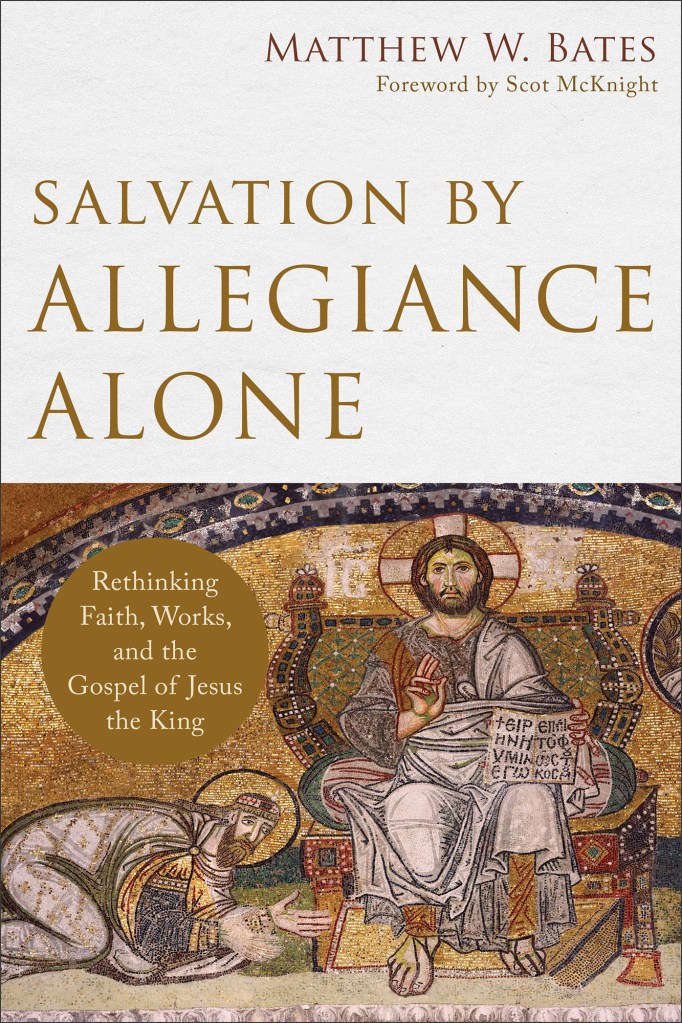
Book Review: Salvation by Allegiance Alone by Matthew W. Bates

Summary

Salvation by Allegiance Alone by Matthew W. Bates can be summed up with one of his early questions: “When the Apostle Paul says, ‘for it is by grace you have been saved through faith’ (Eph. 2:8), what if Paul’s idea of ‘faith’ (pistis) differs from typical contemporary understandings?” (p. 3). The book revolves around that single question, arguing that the Greek word pistis (typically translated as “faith”) ought instead to be rendered “allegiance” or “fidelity.” The title makes this clear. In fact, that sort of blunt clarity is one of the book’s strengths. Whether you agree with him or not, you can’t miss what he’s trying to say.

Continue reading “Book Review: Salvation by Allegiance Alone by Matthew W. Bates”

The Hidden Cost of Losing Inerrancy

If Scripture is not inerrant, then who gets to decide what part of it is true?

This is not a scare tactic. It’s a question of theological method. And one the modern church rarely slows down to ask.

The debate over inerrancy is often portrayed as academic, antiquated, or unnecessary. “Why fight over a word?” some say. “Let’s just focus on Jesus.” But this kind of thinking reveals a dangerous trend: we’ve grown far too comfortable placing Scripture under human evaluation rather than the other way around.

And the moment Scripture becomes suspect, everything becomes negotiable.

Continue reading “The Hidden Cost of Losing Inerrancy”

Why the Moral Argument Deserves a Comeback

Apologetics has no shortage of tools: cosmological arguments, historical evidence for the resurrection, and even design arguments rooted in physics. Yet one particular argument continues to fly under the radar in many academic circles: the moral argument.

For years, I’ve been puzzled by how little attention this argument receives, especially when it continues to be one of the most intuitively compelling arguments for ordinary people. In fact, I once buried my own treatment of the moral argument as a chapter in a broader work (Contending for the Truth), only to realize later that it deserved more visibility. That’s why I’ve now released The Moral Argument as a standalone book. It’s time to give this argument a second look.

Continue reading “Why the Moral Argument Deserves a Comeback”

The Line in the Sand: Why Inerrancy Still Matters

For decades, theologians have debated whether inerrancy is a helpful term, a divisive term, or even a necessary one. Some prefer “infallibility,” others think we’ve outgrown the entire conversation. But here’s the problem: Scripture never gave us permission to step back from what it says about itself.

Continue reading “The Line in the Sand: Why Inerrancy Still Matters”

When Doctrine Gets Personal: Why I Wrote Contending for the Truth

Most Christians know what they believe, but far fewer know why they believe it. And fewer still have taken the time to compare the popular teachings in Christian culture with what the Bible actually says. That tension—between tradition and Scripture, assumption and truth—is where Contending for the Truth lives.

Continue reading “When Doctrine Gets Personal: Why I Wrote Contending for the Truth”